
Building Your Relational Dream Home
Foundations for Any Relationship (Yes, Any!)
by Alissa Bell
Relationships are incredible, complex, and deeply rewarding journeys. Whether you're exploring the rich landscape of a monogamous commitment, navigating an open relationship, building a polyamorous family, navigating kink dynamics, or defining your own unique partnership(s), the desire for a strong, fulfilling connection is universal.
Often, when we think about what makes a relationship "work," our minds might jump to passionate romance, shared interests, or perfectly aligned personalities. While those elements certainly have their place, the truth is that strong and resilient relationships – regardless of their structure – are built from the ground up, much like a well-constructed house.
And when it comes to relational architecture, few frameworks are as insightful as Dr. John Gottman's "Sound Relationship House" theory.
Beyond the White Picket Fence: The Sound Relationship House for All Structures
While Gottman developed their relationship theory mainly around heteronormative monogamous relationships, I believe it has fundamental applicability to all relationship. It doesn't prescribe a specific relationship style or dictate who or how you should love. Instead, it offers a robust blueprint for how to build connection, trust, and intimacy. This framework is incredibly valuable for all relationships, and I find it useful especially those navigating the nuanced dynamics of alternative relationship structures where clear communication and strong foundations are paramount.
Let's walk through the levels of this relational dream home:
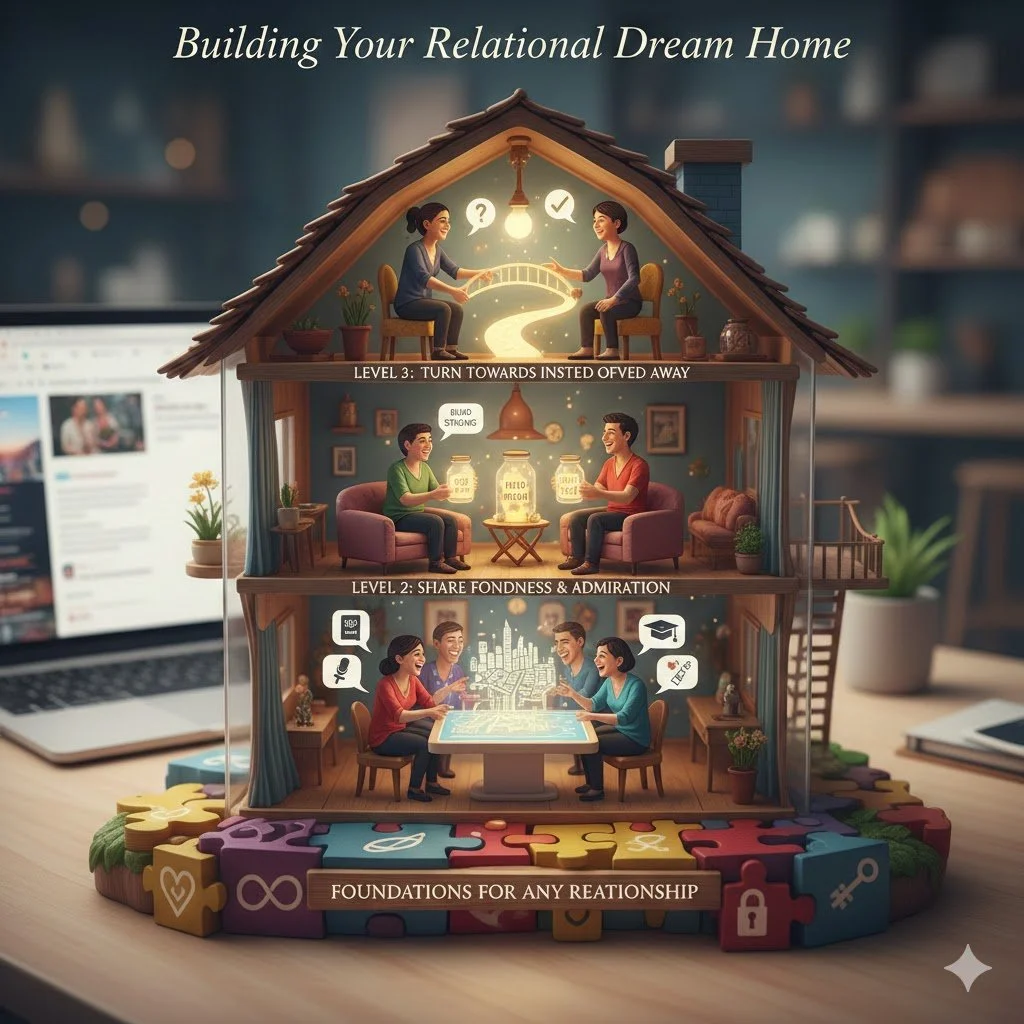
Level 1: Build Love Maps
Think of this as the foundation of your house. Love Maps are essentially your internal knowledge bank about your partner(s). What are their hopes, fears, dreams, quirks, past traumas, current stresses, and future aspirations? Do you know their best friends, their favorite way to relax, their secret ambitions?
In alternative relationships, Love Maps become even more intricate and vital. It's not just about knowing one person deeply, but often understanding the complex interplay of multiple relationships, boundaries, and individual needs within a broader relational ecosystem. Regularly updating your Love Maps through curious questioning and active listening is a continuous process that keeps you intimately connected and interested.
Level 2: Share Fondness and Admiration
This is the strong supporting wall of your home. It's about genuinely liking and respecting your partner(s). Do you regularly express appreciation, affection, and positive regard? Do you genuinely admire aspects of their character, achievements, or how they navigate the world?
This level is crucial for buffering against conflict and maintaining a positive emotional bank account. In any relationship, and particularly in those with unique dynamics, consciously expressing fondness and admiration reinforces the bonds that draw you together and validates each individual's place and worth within the connection.
Level 3: Turn Towards Instead of Away
This is another critical wall, representing the small, everyday moments of connection. When your partner(s) makes a "bid" for your attention – whether it's a sigh, a comment about their day, a shared glance, or an invitation to connect – do you "turn towards" them with engagement, or do you "turn away" or "turn against" them?
These small moments accumulate, building a bridge of trust and responsiveness. For those in multi-partner relationships, learning to turn towards each partner consistently, honoring their bids within established boundaries and agreements, strengthens individual connections while contributing to the overall stability of the relational network.
Level 4: The Positive Perspective
With strong walls, your house starts to feel secure. This level means that when you've built a solid foundation of Love Maps, fondness, and turning towards, you're more likely to view your partner(s) and your relationship through a positive lens. Minor annoyances are less likely to escalate into major conflicts because there's a reservoir of goodwill.
Level 5: Manage Conflict
Every house needs a good roof to weather storms. Conflict is inevitable in any relationship. The goal isn't to avoid it, but to manage it constructively. This involves accepting influence, finding compromise, and understanding that behind every complaint is often a longing or an unmet need.
In alternative relationships, conflict management can involve complex negotiations around time, resources, jealousy, and expectations. Developing robust communication skills, practicing active listening, and committing to fair problem-solving become indispensable tools for navigating these discussions with respect and efficacy.
Level 6: Make Life Dreams Come True
This is about supporting each other's individual aspirations and creating a shared future. Do you understand and support your partner's deepest hopes and dreams? Do you help each other strive for meaning and purpose?
Level 7: Create Shared Meaning
The pinnacle of the house, representing the shared values, rituals, symbols, and goals that give your relationship its unique culture and purpose. This could involve shared traditions, philosophies, or a collective vision for your future, however unconventional it may be.
Beyond the Blueprint: Aligned Goals and Values
While the Gottman House provides an excellent framework for how to build, it's also crucial to acknowledge what you're building with. As my work with individuals and relationships navigating their unique structures consistently shows, relationships thrive when there's an underlying alignment in core areas. The architecture of love is the same, even if the floor plan of your life looks different.
It truly doesn't matter what type of relationship you have – whether it's monogamous, alternative, or somewhere beautifully in between – a strong relationship often starts with:
Aligned Goals: Are you heading in similar directions, both individually and relationally? Do you have a shared vision for the future, even if the path to get there is unique to your structure?
Shared Values: What principles guide your lives and your interactions? Are you both committed to respect, autonomy, growth, honesty, and consent? These are the ethical cornerstones, especially vital in relationships with complex dynamics.
Shared Beliefs: Do you have a common understanding of what "relationship" means to you? What does commitment look like? How do you define family, partnership, and intimacy?
Mutual Interest and Curiosity: A genuine desire to know each other, to explore together, and to remain curious about who your partner(s) are becoming is the fuel that keeps the relational engine running.
Building Your Intentional Future
Ultimately, building a strong base for a sound relationship is an active, ongoing process. It requires intentionality, communication, and a willingness to show up for yourself and your partner(s). The Gottman Sound Relationship House model is based on over 40 years of research with more then 3,000 couples and offers one path and way to fortify your relationship. By also focusing on aligned goals, values, and a deep interest in one another, you can construct a relational home that is resilient, fulfilling, and uniquely yours, no matter its design.
Need help building your relational foundation?
One of our Couples Counselors can help.